





This article is a part of the July/August 2026, Volume 38, Number 4, Audiology Today issue.
By Batoul Berri
Health care systems have become increasingly complex, collaborative, and fast-paced. As a result, audiologists often take on responsibilities that extend far beyond patient care alone. Many find themselves managing workplace conflict, leading initiatives, mentoring staff, and/or making operational decisions without formal preparation.
Although leadership appears throughout clinical and research environments, structured training in areas such as communication, team management, and organizational decision-making remains limited in audiology education. As a result, many clinicians develop leadership skills informally, often while already in roles that require them.
These realities challenge the idea that leadership is a later-career competency. Leadership skills do develop through experience, mentorship, teamwork, and exposure to progressively complex responsibilities. However, that development is often inconsistent and shaped more by circumstance than design.
Dr. Devin L. McCaslin, a recognized leader in the audiology profession with decades of clinical, research, and leadership experience, notes that many of these abilities are currently learned on the job rather than through formal instruction. “Communication, leadership presence, conflict management, and strategic thinking are skills many people have to learn on the job,” he said.
This highlights the need to view leadership not as an optional add-on, but as a core competency developed alongside clinical expertise. Because its development is largely experiential, it varies widely between individuals, contributing to differences in confidence, readiness, and professional growth across the field.
Why Structured Leadership Development Matters
While experience is a powerful teacher, it is not always efficient or comprehensive. Without intentional training, clinicians may take longer to develop key leadership competencies or miss opportunities to refine them early in their careers. Structured programs address this gap by organizing and accelerating experiential learning. Rather than replacing real-world experience, they provide frameworks, feedback, and practical tools that clinicians can apply directly in practice.
Dr. McCaslin emphasizes that leadership is fundamentally relational rather than positional, shaped by collaboration and opportunities for growth.
“Probably the biggest lesson for me has been learning that leadership is much more about people than position or titles,” he said. “The best things I have been part of happened because of strong teams, collaboration, and giving people opportunities to grow.”
He also highlights the value of deliberately stepping into new challenges as a catalyst for development.
“When you look through my curriculum vitae, it is obvious I like to change lanes in terms of my research endeavors,” he said. “Some of the best opportunities in my career came from being willing to step outside my comfort zone…”
Why This Matters Across Career Stages
A common misconception is that leadership development is only relevant later in a career. In reality, these skills apply across all stages of professional development. Because leadership development is often unstructured, clinicians benefit from intentional training throughout their careers. Early-career audiologists gain foundational tools that build confidence and readiness, while experienced clinicians use structured learning to refine and expand existing skills. Leadership development also supports peer learning and professional networking, allowing clinicians to engage with colleagues facing similar challenges.
Communication, adaptability, collaboration, emotional intelligence, and decision-making influence workplace culture, patient experience, and long-term professional growth. Development in these areas supports both individual advancement and stronger team function within health-care systems.
As audiology continues to evolve, leadership will play an increasingly important role in professional effectiveness and influence. However, the inconsistency in how these skills are developed highlights a clear need for structured opportunities that help clinicians build and refine them more intentionally.
Preparing the Profession for the Future
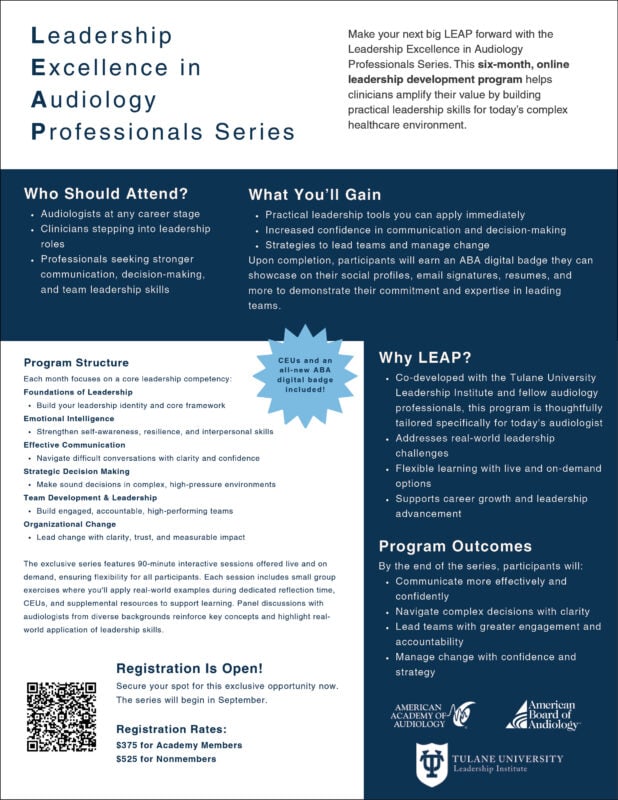
The American Academy of Audiology’s Leadership Excellence in Audiology Professionals (LEAP) Series is designed by the Tulane University Leadership Institute (TULI), a trusted name in leadership development training, to address this gap between experiential learning and intentional skill development. LEAP is an exclusive opportunity to participate in TULI’s six-month leadership curriculum, designed specifically for today’s audiologists in collaboration with audiology professionals to ensure real-world relevance and application. Program modules combine live and on-demand learning, reflective exercises, and audiologist-led panel discussions.
Rather than treating leadership as something that develops incidentally over time, the program helps structure and accelerate that development. It equips clinicians with practical tools that can be applied immediately in clinical and organizational settings. Topics include emotional intelligence, communication, strategic decision-making, team leadership, and organizational change.
“The individuals who will really move the profession forward will be those who can lead teams, advocate for patients, navigate change, and keep the human side of healthcare at the center of what we do,” Dr. McCaslin said.
Programs like LEAP reflect a growing recognition that leadership is not simply acquired through experience alone, but strengthened through structured development that makes that experience more effective and intentional.
The LEAP program begins in September with registration open now. Details can be found online at www.audiology.org/leadership-excellence-in-audiology-professionals-series