







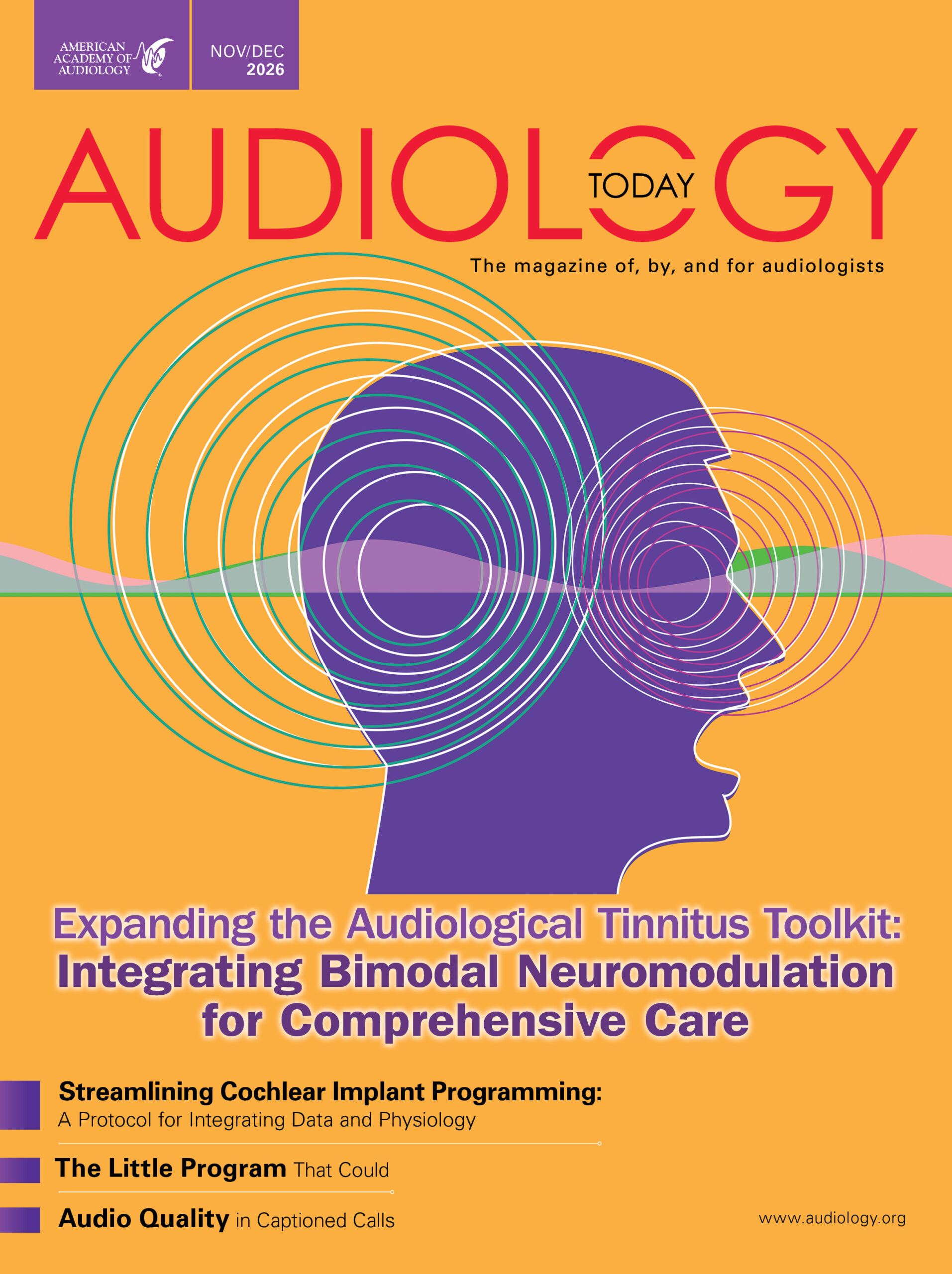

November/December2026 Issue
The November/December 2026, Volume 38, Number 6, Audiology Today issue has been released. Enjoy the most recent issue!
Audiology Today Archives
The Audiology Today issues from 1988 to the present are available as member-only content. Please click the button below to access the archives.
About Audiology Today
Audiology Today, the award-winning publication of the American Academy of Audiology, has been a trusted resource for audiologists for over 35 years. Each bimonthly issue offers evidence-based research, expert insights, and practical ideas to enhance clinical practice and patient care.
Interested in having your work featured? View our editorial guidelines and submit your manuscripts to Editor-in-Chief Erin Schafer, PhD.
Why Submit an Article?
Sharing your insights in Audiology Today is a powerful way to advance the audiology profession and connect with peers. By submitting an article, you can:
-
Contribute to Evidence-Based Practice
-
Have Your Work Recognized
-
Enhance Your Professional Visibility
-
Foster Collaboration
-
Shape the Future
Find Articles from Audiology Today
Keyword Search
Date
Audience
Business Topic
Clinical Topic
Issues


Expanding the Audiological Tinnitus Toolkit: Integrating Bimodal Neuromodulation for Comprehensive Care
Hearing and Balance Specialists of Kansas City was established in 2016 and has grown into a specialty-focused practice operating across three locations in the Kansas City metro, serving both urban and surrounding rural communities.

Streamlining Cochlear Implant Programming: A Protocol for Integrating Data and Physiology
As cochlear implant clinical practice guidelines evolve toward greater efficiency, the path to optimal patient outcomes lies in a balanced clinical protocol that utilizes automated population averages as a foundation for patient-specific objective measures (Holder et al., 2025).
The Little Program That Could
Despite well-established outcomes, CIs remain significantly underutilized in the United States (Neukam et al., 2024). Expanding candidacy criteria have increased the number of individuals who may benefit from cochlear implantation; however, many potential candidates remain unidentified or encounter barriers to referral and access (Neukam et al., 2024; Zwolan & Basura, 2021).