








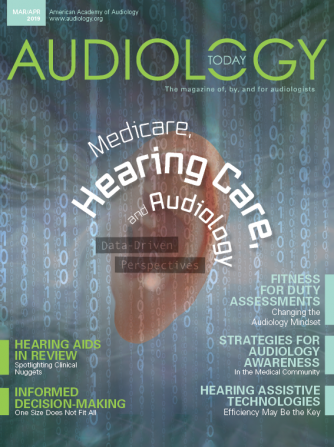
The editorial team and I are so happy to announce the content for this latest issue of Audiology Today. We are featuring a number of comprehensive, relevant, and interesting articles, as well as some short reads on public relations, coding and reimbursement, and audiology advocacy.
Take a look at the table of contents and delve into these online articles, which you can now easily search by topic, title, or author. We appreciate your patience as we continue to upload back issue content, but hope you find this new format easy to explore.
-
- Medicare, Hearing Care, and Audiology: Data-Driven Perspectives By Ian M. Windmill and Barry A. Freeman
-
- Spotlighting Clinical Nuggets in the Upcoming Hearing Aids in Review By H. Gustav Mueller, Catherine Palmer, and Robert Turner
-
- Informed Decision-Making: When One Size Doesn’t Fit All By Katie Oestreich
-
- Fitness for Duty Assessments for Jobs: Audiology Mindset (Part 1 of 2) By Sigfrid D. Soli, Ross Roeser, and Veronique Vaillancourt
-
- Strategies for Increasing Medical Community Awareness of Audiology By Don Nielsen and David Fabry
-
- Increasing Hearing Assistance Technology (HAT) Awareness By John Greer Clark and Brittany Gilb
Erin Schafer, PhD, is the editor-in-chief of Audiology Today and www.audiology.org.
Recent Posts

Treatment of Parkinson’s Disease with Virtual Reality
In a recent article by Mahato et al. (2026), 250 individuals with Parkinson’s disease were assigned to either traditional physical therapy or virtual reality (VR)-based…

SPAN Q4 Meeting Reminder
The American Academy of Audiology’s State Policy Advocate Network (SPAN) will hold its fourth-quarter meeting next week, on October 28, 2026, from 8:00–9:00 pm ET….

Virginia Audiology Regulations Open for Public Comment
The Virginia Board of Audiology and Speech-Language Pathology published a proposed rule allowing for ABA certification to serve as an alternative pathway for audiology licensure….
